




Business onboarding, API-powered Next: AI-enabled health data

Product Design & Research · Kamoa

Using AI and ML to Improve Credit Access for Small Businesses in Emerging Markets

Creating an advanced credit scoring system for small businesses in emerging countries using AI and machine learning.

Lead Product Designer & Product Owner  ·  12 weeks  ·  Kamoa

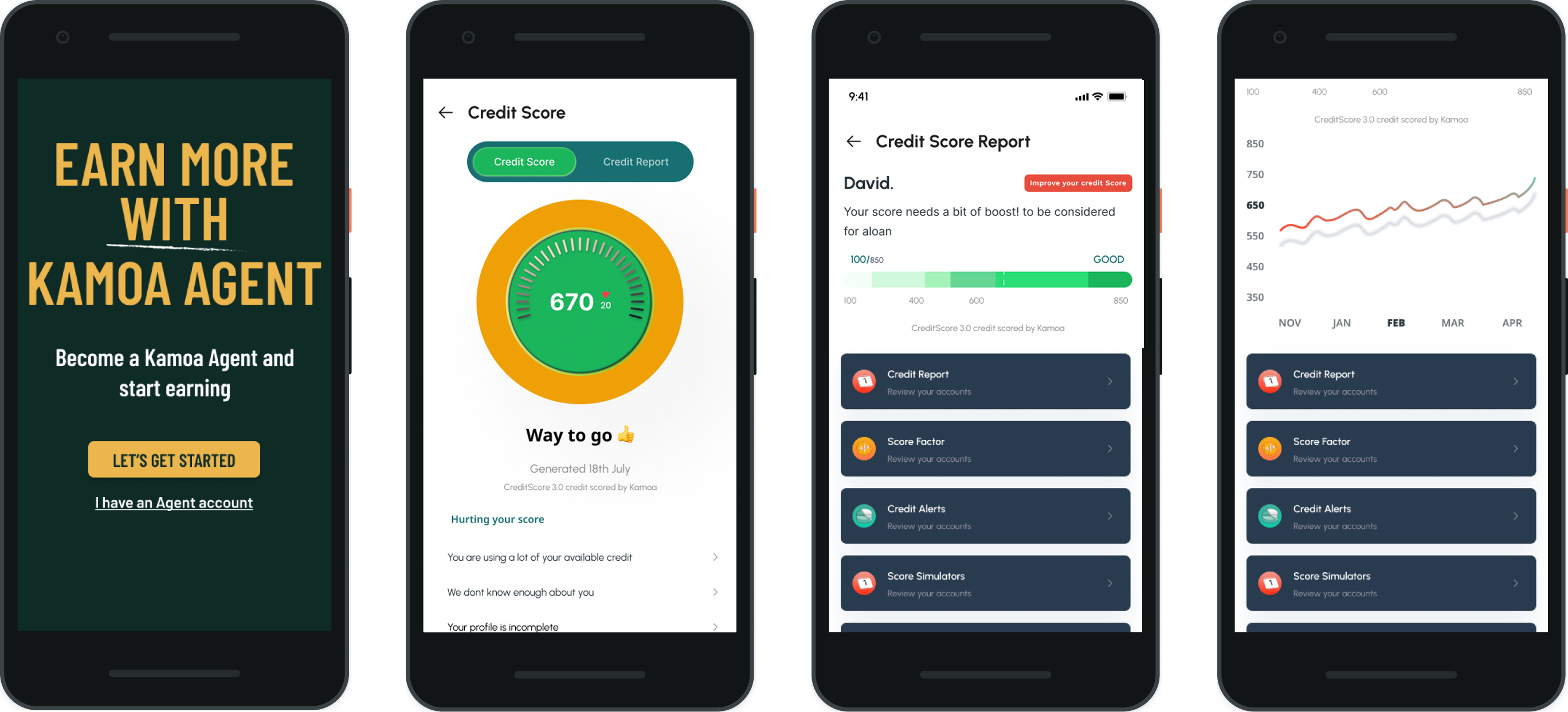
Kamoa hero — the four app screens on green

Inside Africa's first user-powered financial marketplace.

Kamoa is dedicated to putting control back in the hands of those who need it the most by helping individuals and small businesses build their access to mainstream credit and access affordable loans.

Market problem

Small and medium-sized enterprises (SMEs) are a significant force in the global economy, comprising approximately 90% of businesses and over 50% of employment worldwide. In emerging economies, formal SMEs contribute up to 40% of the national income (GDP) and are a top priority for governments. These businesses are responsible for generating the majority of formal jobs in emerging markets, accounting for 7 out of 10 jobs. Despite numerous challenges, such as limited access to finance, skill gaps, competition from larger corporations, complex regulations, and inadequate infrastructure, SMEs in Africa face additional obstacles like political instability, security threats, and corruption. Nevertheless, there are substantial opportunities for SMEs in Africa, and the government is taking measures to support their growth.

Final outcome

2M

Downloads

800K

Active users at its peak

40%

Of active users uploaded a financial statement

8

Partner lenders: Branch, MyWagePay, LendPlus, Factorhouse, Izwe Loans, MoPhones, Etica MMF, Bayes

Part of the world bank's initiative is to help SMEs Improve access to Finance and Economic Opportunities in Africa. Through the strategic development of a data model and a credit scoring tool, this initiative successfully addressed the financial challenges faced by SMEs. The project not only improved lending processes for financial institutions but also contributed to the broader goal of enhancing financial inclusion and supporting the growth of SMEs in the local economy.

Reliable Credit Monitoring tool

The app provides users with free access to their credit scores and credit reports from major credit bureaus like Credit info Kenya, Credit Reference Bureau (CRB) and individual generated financial statements. Users can regularly check their credit scores and monitor changes to their credit reports.

User Data Monetization

Kamoa app may aggregate and anonymize user data to provide market insights and trends to their app users.

Automating MFIs processes

This brought notable benefits like Faster Loan Processing that streamlined loan application processing, reducing the time it takes to approve and disburse loans for SMEs.

KYC API integration

Integrating KYC (Know Your Customer) The kamoa APIs brings efficiency by automating identity verification, reducing costs, and enhanced compliance, It also minimizes human errors in data entry, calculations, and record-keeping, leading to more accurate operations.

See the product as it is today →

My role
Lead Product Designer and Product Owner, working with the marketing team and an ML engineer
Timelines
12 weeks
Tools
Figma and FigjamWhatsapp, Zoom, google meetsUsertesting
Design system
Material design

Discovery

Understanding the problem

Problem

Microfinance institutions (MFIs) find it hard to give loans to small and medium-sized businesses (SMEs) because of money, rules, and lack of know-how. Also, many SMEs don't have good credit scores, making it tough for MFIs to tell if they can repay loans. This holds back SMEs, which are crucial for the economy.

Impact

Not having a good credit score is a big issue for SMEs because lenders use it to decide if they can trust someone with a loan. When SMEs don't have a good score, MFIs have to take bigger risks or charge more interest.

Solutions

To get better credit scores, SMEs can do a few things. They can pay bills on time, They can also look into different ways of showing they can repay loans, like paying rent and utility bills on time. These solutions help SMEs have better credit scores and solve the problem of not having a reliable one.

Research

In our recent field research in Nigeria and Kenya, we discovered significant challenges faced by SMEs in accessing financial institutions for funding and credit

  • Lack of credit history: SMEs, especially newly established businesses, have limited or no credit history. This makes it difficult for financial institutions to assess their repayment capacity and determine interest rates.
  • Lack of proper financial documentation: Incomplete financial statements, unorganized bookkeeping, or inconsistent financial reporting can create doubts about the SME's financial stability and hinder loan approvals.
  • Lack of collateral: Financial institutions often require collateral as security for loans. SMEs with limited assets may struggle to meet these requirements.

Objectives & goals

  • Developing credit scoring systems that are tailored to the needs of SMEs.
  • Providing financial education and training to SMEs on how to manage their finances and build a credit history.
  • Developing alternative forms of collateral, such as guarantees from government agencies or other businesses.
  • To raise awareness of the challenges faced by SMEs in accessing financial institutions.
  • To advocate for policies and programs that support SMEs.
  • To develop and implement solutions to the challenges faced by SMEs.
  • To measure the impact of the solutions implemented.

Business challenges

How can we enable Microfinance Finance Institutions (MFI ) to access best in class technology and mobile loan origination that will be of benefit to SMEs

Product user

  • Individual looking to improve their credit score
  • SMEs looking to improve their credit score
  • A financial institution that offers loans to individuals with a proven track record of financial responsibility.

Competitor analysis

Competition is from both established players and emerging startups in the financial technology (FinTech) and credit analytics space. this include

  • Ecobank
  • AfriCDSA
  • CreditInfo
  • Branch
  • Blockchain-based credit scoring
  • Syft
The competitor landscape, plotted on market presence against satisfaction. Read more on the competitor landscape here

Definition

Understanding user needs

The persona

  • Individual looking to improve their credit score
  • A financial institution that offers loans to individuals with a proven track record of financial responsibility.

Design challenge

SMEs in emerging markets face difficulties obtaining loans from banks due to a lack of credit history. Banks determine interest rates based on credit scores, which assess an individual's risk by analyzing their past credit activity using statistical models.

How might we

"How might we help an SME prove they're creditworthy when they have no credit history?"

User needs

These were the key needs that surfaced during our research in the two countries

User needs

How to address

Access to credit

Provide more flexible lending criteria, such as shorter repayment terms and lower interest rates.

Improved credit assessment

Use alternative data sources, such as payment history on utility bills and rent payments, to assess creditworthiness.

Solutions for creditworthiness

Provide educational resources and training on how to improve credit scores.

Awareness and education

Raise awareness of the importance of creditworthiness and alternative credit assessment methods.

Reduced borrowing costs

Reduce the risks perceived by MFIs, such as by providing collateral or guarantees.

Efficient financial services

Streamline the loan application process and reduce bureaucracy.

Financial inclusion

Develop alternative credit scoring methods that are accessible to all businesses.

Economic growth

Support policies that promote entrepreneurship and small business development.

Job to be done

The team brainstormed on Jobs to he done statements that helped gain further clarity on the audience goals, this could serve as reference for further decisions

Customer goals and motivation, customer challenges, and jobs to be done, mapped with the team.

Ideation

Every designer favourite playing ground

01

Priority features

The solutions were the ideas we had validated for the problems that were deemed worth addressing. (Note that the solutions above had not been fully validated in terms of features.) The MVP build was intended to facilitate swift and early testing in this regard. We focused on developing features to production-grade only when they showed a strong probability of effectively addressing the end user's problem.

Artefact

Journey — Increasing Credit Worthiness through a Credit Scoring App for SMEs.

Ten steps in the SME journey

Registration and onboarding · Profile setup · Credit assessment · Credit score presentation · Credit building guidance · Access to financial products · Monitoring and maintenance · Support and assistance · Achieving credit goals · Future financial success
The SME journey, from onboarding to credit monitoring. Select to view full size.
02

Wireframes

With the user at the core, I crafted rapid wireframes, Presented to our target customers, these gave a glimpse of the final product's potential look. This guided our design system team, providing clarity on the pipeline ahead.

Rapid wireframes, in flow order: login, tutorial, document upload, upload instructions, credit score, credit score report, profile. Select any to view full size.

Decisions

Two calls the screens don't explain on their own

Why we asked users to upload an
M-Pesa statement

Getting consumer M-Pesa transaction data was not as simple as connecting a bank account through a standardised open-banking flow. Safaricom provides APIs for M-Pesa services, but the available infrastructure gave us no straightforward, plug-and-play route to a user's historical statement.

Rather than make financial-data connectivity a prerequisite for validating the product, we chose a manual-upload model. It introduced real friction, but it gave us the twelve months of transaction history the model needed without handling anyone's M-Pesa credentials.

The trade-off

Sacrifice convenience to reduce infrastructure dependency and validate the core proposition first. The five-step instruction screen is the evidence: we knew the friction was there and chose to guide people through it rather than solve the connectivity problem before we knew the product worked.

Designing for a model you can't see inside

I treated explainability as a UX problem rather than an ML problem. We couldn't show users the model's internals, so I designed for outcome-level transparency.

Score Factors explained what was influencing the score. "Hurting your score" translated those same signals into behaviours a person could recognise and act on.

The principle

Don't expose a black box. Give the user enough context to trust the decision and act on it.

Prototypes

Almost there: mid-fidelity prototypes

In the mid-fidelity phase, the app's wireframes were converted into high-resolution mockups. These mockups were visually appealing and engaging, and accurately represented the app's functionality. We did several usability session with the user and main stakeholders to test the app user experience and functionality.

Read more on my learnings here

01 · Tutorial. Three cards, skippable, ending in the one action that matters.
02 · Empty state. Format and size limits stated before anything is chosen.
03 · Instructions appear with the choice, not in a help centre.
04 · Attached. Submit turns live, and more documents mean a better score.
05 · The score, then the three things dragging it down.
06 · The report. Where the number came from, and what moves it.

Testing

Evaluating and validating our ideas with users

My team and I conducted a usability test to assess the usability of a credit score tool using AI. The test was conducted with a small group of potential users to get their feedback on the tool's design and functionality. The results of the test will be used to improve the tool and make it more user-friendly.

User feedback

  • The instructions for entering personal information should be clarified and simplifies
  • Most said the navigation of the tool should be improved.
  • 30% of the users felt that the accuracy of the information should be improved
  • 100% of the users found the tool to be informative and helpful.
  • 60% of the users found the tool to be reliable and accurate.

What testing changed

Three of the findings were specific enough to redraw a screen. Each pair below is the wireframe that was tested and the design that replaced it.

Finding

"The instructions for entering personal information should be clarified and simplified."

Change

The flat list of statement instructions became a numbered sequence that only appears once a document type is chosen, with a route out for anyone without the M-Pesa app.

Before
After

Finding

"Most said the navigation of the tool should be improved."

Change

Generic tabs — home, search, loans — were replaced by the five things people came to do, with Credit Score first rather than buried behind a home screen.

Before
After

Finding

"30% of the users felt that the accuracy of the information should be improved."

Change

A score people can't interrogate is a score they don't trust. The placeholder became a six-month trend against the market, the scale moved to the bureau's 100–850, and Debt Analysis was added to the report.

Before
After

Final marketing designs

The app is available for the Nigerian and Kenya market on the play store follow this link to download

The Play Store listing: five panels, one promise each.

Where it is now

From a credit score to a financial marketplace

The scoring tool was the entry point. What it opened up was everything a small business does around credit: work out what a loan will cost before taking it, compare lending products from partner institutions, and read your own cash flow back to you.

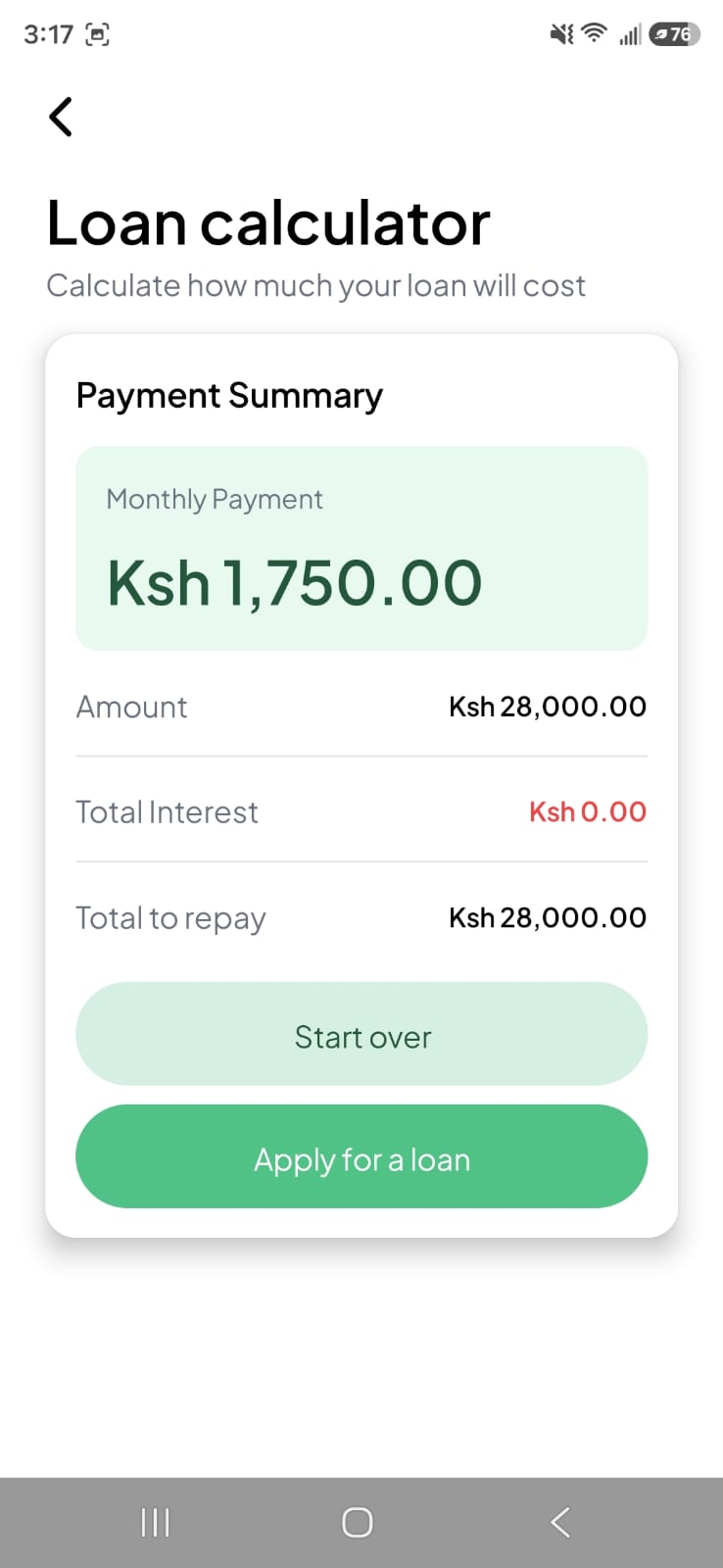
Loan calculator payment summary: monthly payment Ksh 1,750.00, amount Ksh 28,000.00, total interest Ksh 0.00, with Start over and Apply for a loan buttons.
Loan calculator. The cost of borrowing, before applying.
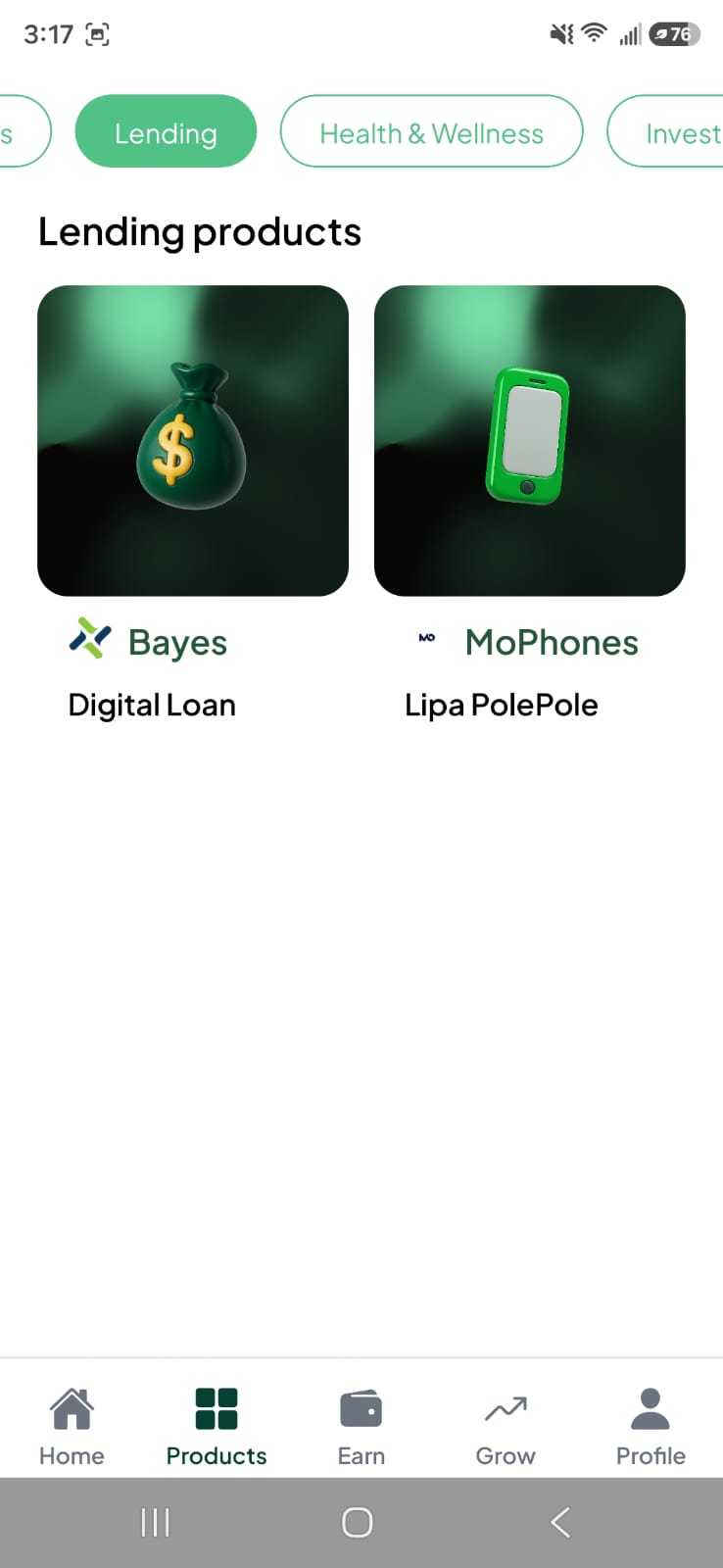
Lending products tab showing Bayes Digital Loan and MoPhones Lipa PolePole as cards.
Lending products from partner institutions, in one place.
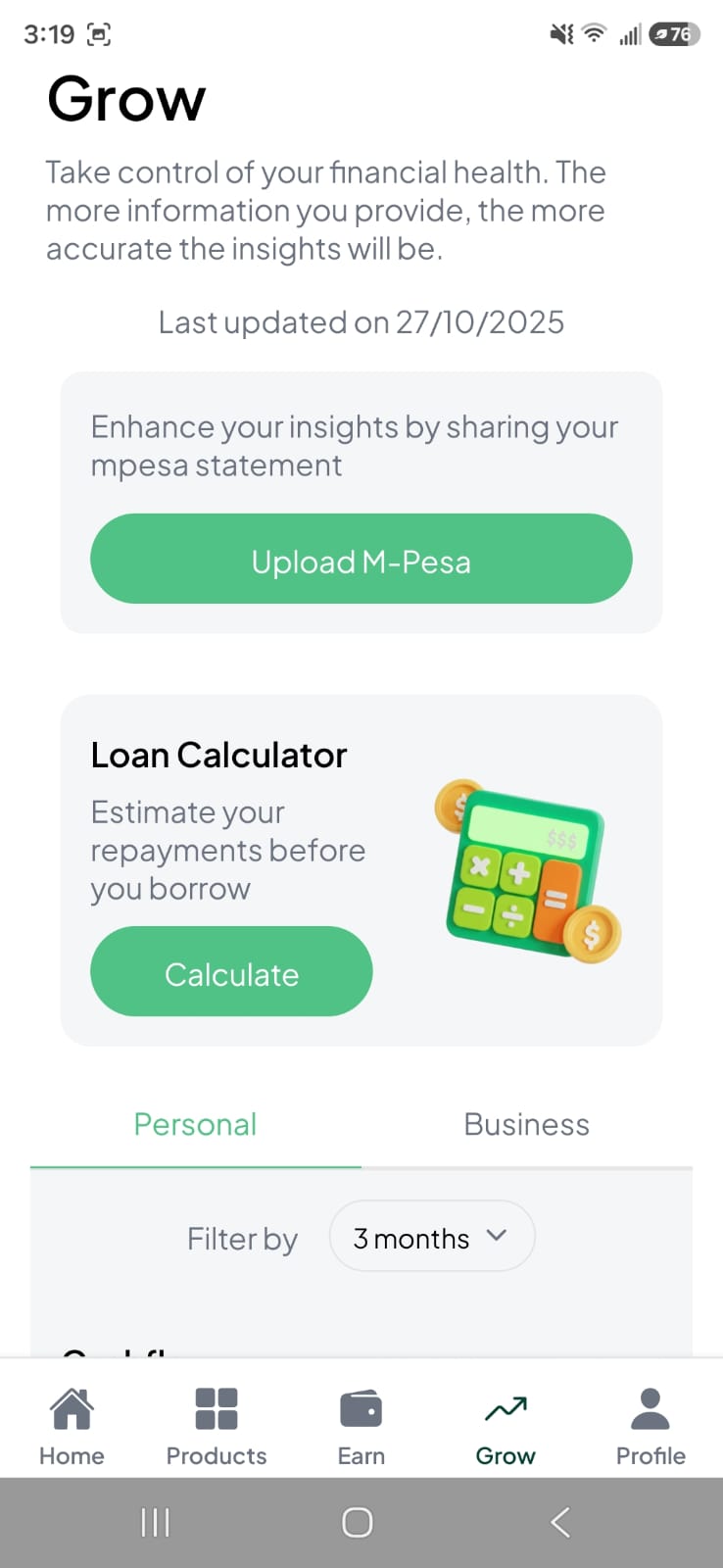
Grow tab with an Upload M-Pesa prompt, the loan calculator card, and Personal and Business filters.
Grow. The M-Pesa statement is still the fuel — now it buys insight, not just a score.
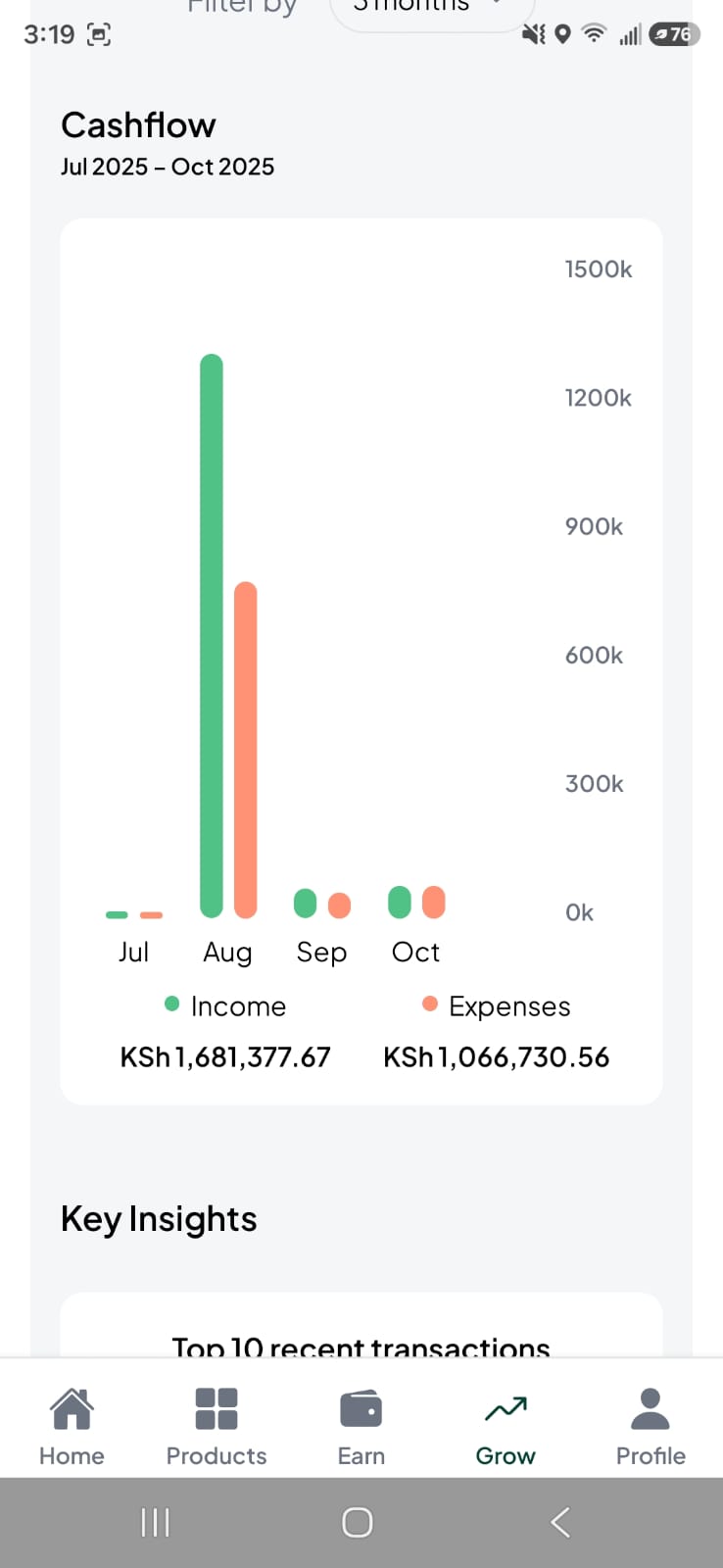
Cashflow chart for July to October 2025 with income and expenses bars and totals.
Cash flow, income against expenses, four months at a time.
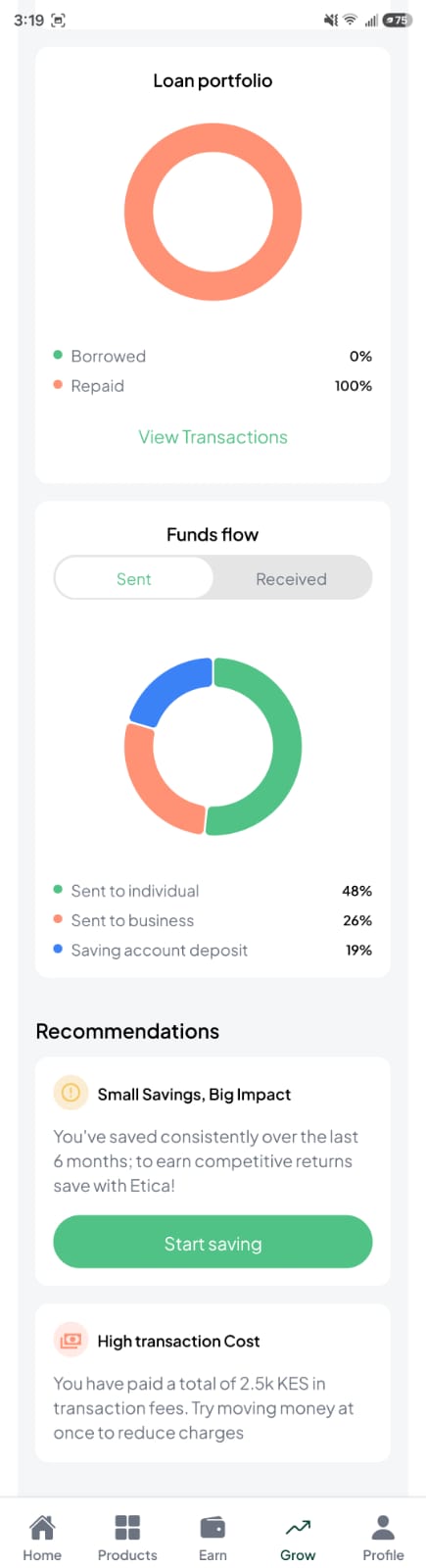
Loan portfolio and funds flow donut charts above two recommendation cards: Small Savings Big Impact and High transaction Cost.
Portfolio and recommendations. Insight only counts if it names the next action.

Takeaways

Key takeaways

Impact

  • Building a credit score using AI can have a significant impact on the financial industry. It can make credit scores more accurate and fair, and it can help lenders make better lending decisions.
  • It can also help consumers better understand their credit and make better financial decisions.

Learning

  • The development of AI-based credit scoring models requires a robust data infrastructure. This includes data on borrowers' financial history, payment behavior, and other factors that can be used to predict their creditworthiness.
  • It also requires strong data privacy and security measures to protect the confidentiality of personal and financial data.
  • The development of AI-based credit scoring models must also adhere to legal and ethical guidelines surrounding the use of personal and financial data. This includes ensuring that models are not biased against certain groups of people.

Read more of my learnings here

Next steps

  • Collaboration with credit bureaus, financial institutions, and regulatory bodies is essential to establish standardized practices and ensure the responsible use of AI in credit scoring. the Biz dev and customer success team will be creating channels for this conversation.
  • This collaboration will help to ensure that AI-based credit scoring models are accurate, fair, and transparent.
  • The Design team together with the Customer success team will collaborate to get user feedback, through prompted survey and data analytics events
← Previous project Business onboarding, API-powered All case studies Next project → AI-enabled health data

Like what you see?

Let's work together

A simple hello could lead to a life-changing conversation. A shared experience could spark a revolutionary idea. The possibilities are endless, so let's connect and see what happens!

Email me LinkedIn
{{ shotImg }}

{{ shotCap }}